
You are accountable for what must be achieved.
Organizations can see activity.
What is harder to see is whether everything important is actually moving together.
Yet you are still accountable.
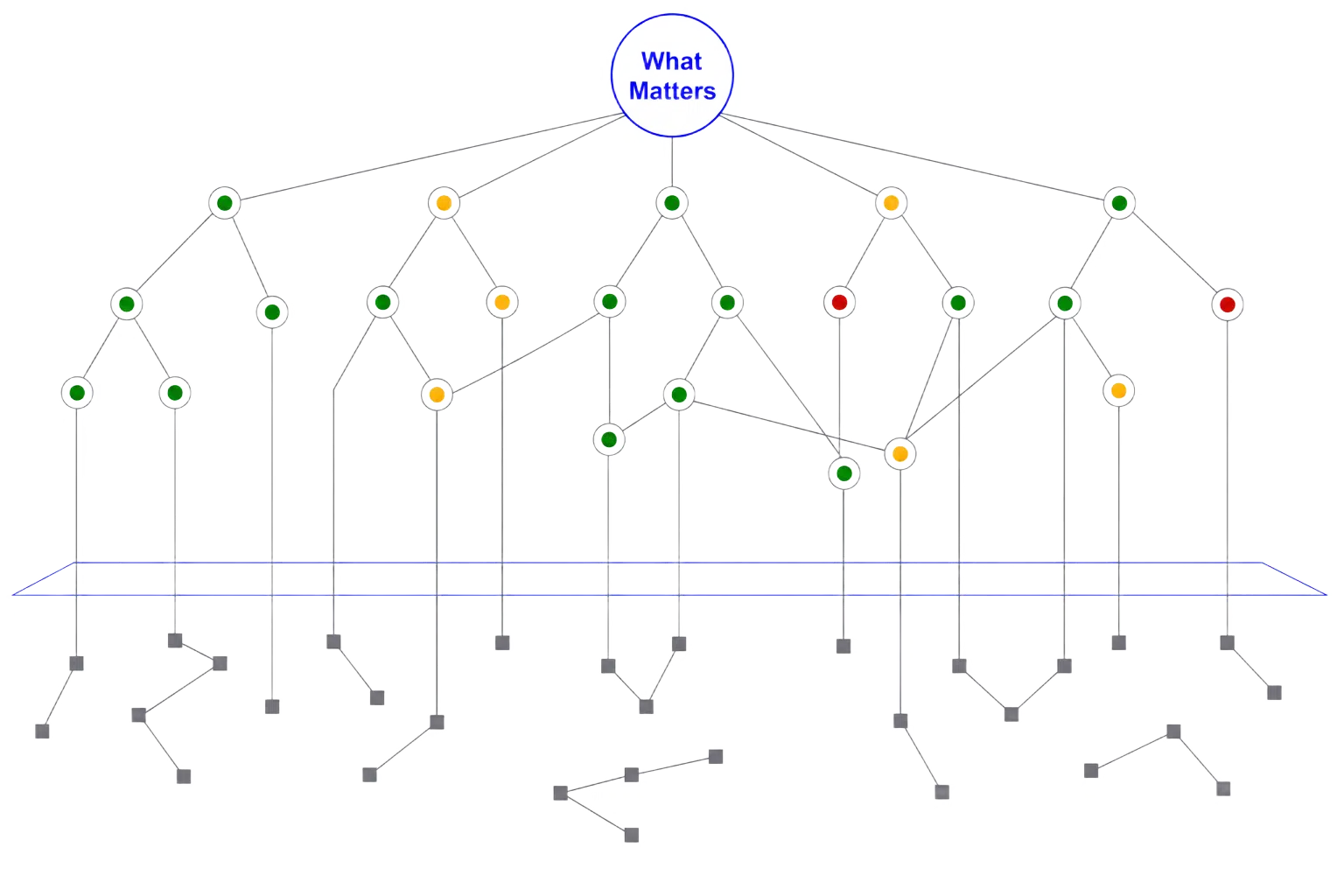
Organizations already have systems for managing activity.
Organizations already have strategy, plans, project management, operations systems, KPIs, dashboards, meetings and communications.
The missing layer is not more activity management.
It is a maintained representation of the required achieved states and the causal relationships among them.
Existing systems manage much of how work gets done.
Shared Performance manages what must be achieved, why, how those Achievements causally come together, and whether they will.
Achievement Management
Shared Performance is Achievement Management: establishing and continuously managing what must be achieved, how it must come together, and whether it actually will.
At its foundation is an authoritative representation of what must be achieved, who owns it, how it causally comes together, and whether it remains capable of success.
Existing ERP, CRM, project, workflow, development, collaboration and other systems can remain in place.
Shared Performance provides the missing what-and-why context above and across them.
Real Enterprise Findings
Enterprise planning environments can appear aligned until deeper structural review occurs.
What initially appears connected may expose:
- disconnected priorities,
- inconsistent ownership structures,
- missing supporting work,
- fragmented planning approaches,
- missing future indicators,
- overdue indicators,
- and operational gaps that are difficult to clearly identify beforehand.

Findings from a representative enterprise implementation.
When structural gaps remain hidden, there is less time to intervene.
Required Achievements may be missing, poorly defined, disconnected, unowned, overloaded, unsupported, or visible only after failure reaches lagging measures.
The result can include:
- wasted work against incomplete plans,
- dependency surprises and cross-functional misses,
- pushes, delays and surprises,
- and less time for leadership to intervene while the result can still be influenced.

The System of Achievement
The System of Achievement is the management system combining the discipline, process, services and supporting technology required to manage achievement.
It establishes and maintains the authoritative representation of what must be achieved and how it must come together.
Important organizational priorities can depend on Achievements distributed across different owners, functions, systems and organizational boundaries.
The System of Achievement helps organizations identify what matters, what is missing, where risk exists, and whether important priorities are realistically capable of coming together.


SP Attain supports the System of Achievement.
SP Attain is the software platform that sustains the System of Achievement.
It provides the environment for managing Achievements, ownership, dates, status, indicators, causal relationships, supporting information, security, history, attachments and connections to execution systems.
Existing ERP, CRM, project, workflow, development, collaboration and other systems can remain in place and be linked to the Achievements they help deliver.
AI still needs context.
AI can increasingly infer relationships, summarize content, generate plans and build dashboards.
AI strengthens the need for explicit organizational intent and an authoritative representation of it.
AI still needs to understand:
- What must be achieved?
- Why?
- Who owns it?
- What contributes to what?
- Whether it will actually come together?
The authoritative representation provides that context.
AI supports Achievement Management. It does not become the category.

Built for organizational complexity.
Shared Performance has been used over long periods in enterprise environments.
Its U.S. patent family includes issued patents from 2018, 2021 and 2025, with a further continuation pending.
The System of Achievement and SP Attain address environments where consequential outcomes depend on Achievements, ownership and dependencies coming together across organizational boundaries.